
A skill gap analysis gives you a prioritized list of 3 to 5 development gaps, ranked by impact, plus evidence you can put in front of a manager during a review or a raise conversation. That's the entire point of doing one. Here's what to do in the next 30 to 60 minutes:
- Pick your target: a specific role, level, and context (not "get better at leadership").
- Extract 5 to 10 required skills from real job postings or a competency framework for that target.
- Rate yourself on each skill using a simple 1 to 4 or 1 to 5 scale.
Pro Tip: Don't skip straight to the scoring. The whole analysis falls apart if your target role is vague, so spend five extra minutes making it specific before you rate anything.
The rest of this guide covers the scoring template, a prioritization matrix, a 90-day action plan, and a private tracking method for the evidence itself.
Key Takeaways
A personal skill gap analysis works when you pair a consistent rating scale with real evidence for every claimed skill level, then prioritize by impact before effort.
| Point | Details |
|---|---|
| Get specific on your target | A vague target role produces a vague gap list; name the title, level, and context. |
| Use live postings for skills | Pull 5 to 10 job postings and count skills appearing in 3 or more for a consensus list. |
| Rate consistently, then rank | Use one scale throughout, then prioritize by impact and effort, not by what feels urgent. |
| Attach evidence to every rating | A score with no artifact, metric, or feedback behind it won't hold up in a review. |
| Track weekly, export when needed | Lookatyougo captures 90-second weekly check-ins and turns them into a private, exportable evidence pack. |
Table of Contents
- What Is a Personal Skills Gap Analysis?
- How Do You Run a Skill Gap Analysis?
- Skill Gap Analysis Template and Scoring Example
- How Do You Prioritize Which Gaps to Close First?
- Turning Priority Gaps Into a Measurable Development Plan
- How Do You Track Progress and Build Evidence for Reviews?
- How Often Should You Validate and Update Your Analysis?
- What Biases Distort Self-Assessment?
- A Gap Is Data, Not a Verdict
- How Lookatyougo Turns This Into a Ready Evidence Pack
- Frequently Asked Questions
- Sources
What Is a Personal Skills Gap Analysis?
A personal skills gap analysis compares your current abilities against what a specific target role actually requires, then turns the difference into a focused development plan. It's a structured comparison, not a vague self-improvement exercise, and it produces a ranked list you can act on, according to MindTools.
This is not the workforce version HR teams run across an entire department. This is yours alone, built for one purpose: getting you ready for a promotion, a pay negotiation, or a career move. To ground it in something concrete, pull from:
- Real job postings for your target title
- Competency frameworks your industry or company already publishes
- SMART goals to structure whatever you decide to work on
How Do You Run a Skill Gap Analysis?
You can build a usable analysis in one sitting, roughly 1 to 3 hours, if you follow a tight sequence instead of freewheeling through a list of "skills to improve."
- Choose a specific target. Not "senior manager." Try "Senior Product Manager, B2B SaaS, leading a team of 4." Career strategy experts point out that the biggest mistake people make is assuming the next level just needs more of the same skills, when it usually demands different capabilities entirely.
- Collect required skills from live sources. Pull 5 to 10 postings for your exact target title. Count the skills that show up in three or more of them. That recurrence is your signal. This method of building a consensus required-skill list beats guessing based on your current job description, because it reflects what the market is actually hiring for right now.
- Rate yourself on a consistent scale. A 1 to 4 scale works well: 1 (aware), 2 (developing), 3 (proficient), 4 (expert). Use the same scale for every skill so gaps are comparable.
- Gather evidence for each skill. For every rating above a 1, attach something real: a work sample, a metric you moved, a piece of peer feedback. A number with no evidence behind it won't hold up in a review conversation.
- Prioritize and pick your top 3. Resist the urge to work on everything. Mirrai Careers recommends narrowing to 3 gaps and ranking them by impact and effort, which sets up the 90-day sprint you'll build later in this guide.
Pro Tip: Do steps 2 and 3 in the same sitting. Rating yourself right after you've read real job postings keeps your self-assessment anchored to the market, not to how you felt about your last performance review.
- Give yourself permission to rate honestly, including the low scores.
- A gap isn't a failure. It's just the distance between where you are and where you're going.
Skill Gap Analysis Template and Scoring Example
A consistent scale is what makes the whole exercise usable later, especially when you're comparing gaps across very different kinds of skills.
The 1 to 4 scale:
- 1, Aware: You understand the concept but haven't applied it.
- 2, Developing: You've applied it with support or in limited scope.
- 3, Proficient: You do this independently and reliably.
- 4, Expert: Others come to you for this; you could teach it.
Here's what one filled row looks like in practice, based on the spreadsheet structure Mirrai Careers suggests for turning subjective ratings into an objective priority order.
| Field | Example Entry |
|---|---|
| Skill | Stakeholder communication |
| Source count | Appeared in 3 or more postings |
| Current level | 2 |
| Target level | 4 |
| Gap | 2 |
| Evidence to attach | Link to a deck, meeting notes, or a peer quote confirming the impact |
Capture the raw evidence as you go: dated artifact links, a one line impact statement, and who can corroborate it. That last column is what turns a spreadsheet into something you can actually present.
- Keep evidence links in a private folder, not scattered across email threads.
- Date every entry so you can show progress over time, not just a snapshot.
How Do You Prioritize Which Gaps to Close First?
Not every gap deserves your time. An impact times effort matrix (or impact times gap size, if you prefer) turns a long list into a short one you'll actually finish.
| Quadrant | What Goes Here | What to Do |
|---|---|---|
| High impact, low effort | Skills close to your current level that matter a lot for the target role | Do these first |
| High impact, high effort | Critical stretch skills far from your current level | Pick one, build a 90-day plan |
| Low impact, any effort | Nice-to-haves that don't move the needle for this role | Backlog indefinitely |
- Start with high-impact, low-effort items. Quick wins build momentum and give you early evidence.
- Choose one stretch-but-critical item you can't skip, even if it's slow-going.
- Weigh visibility alongside gap size. A moderate gap in something your manager watches closely (say, presenting to leadership) often outranks a bigger gap in something nobody notices day to day.
Turning Priority Gaps Into a Measurable Development Plan
Each of your top 3 gaps needs a SMART goal: a specific outcome, a way to measure it, a timeframe, and the evidence you'll collect along the way. Vague goals like "improve leadership" don't survive contact with a busy quarter.
- Define what "closed" looks like. A deliverable, a metric, or a milestone, not a feeling.
- Match the action to the gap type. Technical gaps often close fastest through a course or certification. Leadership and communication gaps close faster through on-the-job stretch assignments and coaching conversations, since research on career gaps points to sprints built around real deliverables rather than passive learning.
- Set a 90-day sprint per gap. Block weekly time, even 90 minutes, and build one demonstrable artifact by day 90: a project, a presentation, a process you redesigned.
- Check in at 30, 60, and 90 days. Ask yourself what evidence you've collected, not just whether you feel more confident.
- Technical gap example: complete a certification, then apply it on a real project within 60 days.
- Leadership gap example: lead one cross-functional meeting per month, and log feedback after each one.
- Communication gap example: present findings to a wider audience quarterly instead of just your immediate team.
How Do You Track Progress and Build Evidence for Reviews?
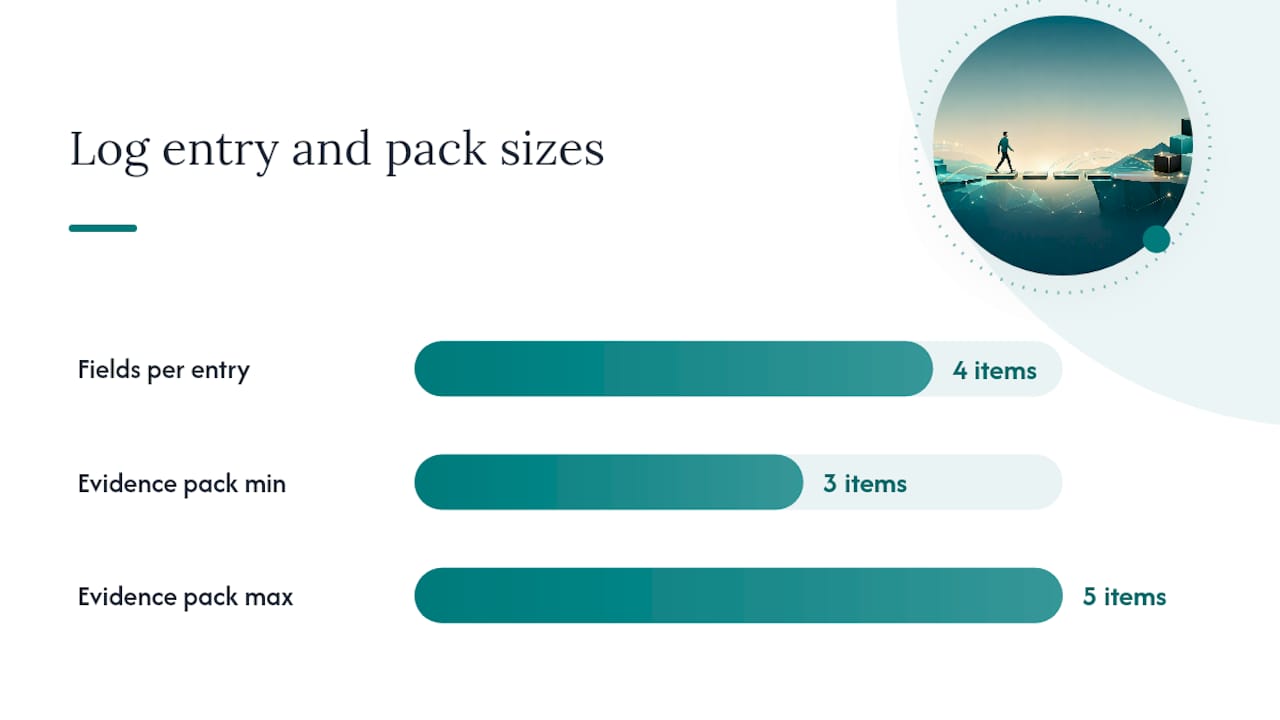
A weekly or sprint-based logging habit is what separates a skill gap analysis that gathers dust from one that actually shows up in your next review. Every entry needs four things: the metric or outcome, your role in it, the date, and the result.
Pro Tip: Convert raw notes into the STAR format, Situation, Task, Action, Result, as you go rather than scrambling to reconstruct context six months later. A one-line note today beats a foggy memory at review time.
| Log Entry Field | What to Capture |
|---|---|
| Date | When it happened |
| Skill/gap it relates to | Link back to your priority list |
| Result | The measurable outcome, however small |
| Evidence | Link, screenshot, or quote |
- Log entries privately, in a tool only you control, not a shared team doc.
- Every few weeks, pull your strongest entries into a short evidence pack: 3 to 5 impact statements ready to hand to a manager.
- Share only the specific evidence you choose for a specific conversation. Your full log stays yours.
How Often Should You Validate and Update Your Analysis?
Self-ratings drift without a reality check, so a short calibration conversation matters. Ask a manager or mentor two things: "Where would you rate me on this skill?" and "What's one thing that would move me up a level?"
- Fast-moving fields (tech, product, sales): recalibrate quarterly.
- Most other roles: six-month baseline works well.
- Every role, no exceptions: revisit at least annually.
- Record validation in writing, an email summary or meeting notes, so it becomes evidence too.
- A manager's confirmation of a skill level is often stronger proof than your own log entry alone.
What Biases Distort Self-Assessment?
Self-assessment without evidence is unreliable, according to research on personal skill gap analysis, and three biases explain most of the distortion. Dunning-Kruger effect: the less you know about a skill, the harder it is to judge your own level in it accurately. Optimism bias: you'll tend to round your own scores up, especially on skills tied to your identity. Recency bias: a great week or a rough one skews your rating far more than it should.
- Require at least one observable artifact per claimed skill level, no exceptions.
- Get a peer or manager to sanity check any rating of 3 or higher.
Pro Tip: If you can't produce evidence for a rating within two minutes, downgrade it by one level until you can.
A Gap Is Data, Not a Verdict
Treat a skill gap as navigational information, something that tells you where to steer next, not proof you're falling short, an idea career strategist Dorie Clark has championed for years.. Run this process honestly, and you'll finish with a shorter, sharper list of priorities than you started with.
How Lookatyougo Turns This Into a Ready Evidence Pack
Running the analysis is the hard part. Keeping the evidence organized for six months until your next review is the part most people quietly abandon. Lookatyougo is built for exactly that gap: instead of a spreadsheet you forget to update, you talk for 90 seconds a week, and it turns that into a structured record of outcomes, skills, and feedback tied to your priority gaps.
Everything stays private. No employer access, no manager dashboard watching your ratings drift. You control what gets shared and when, which matters most exactly when you're about to walk into a pay negotiation with a folder of your own evidence instead of a vague memory of "a good year." When it's time to talk numbers, Lookatyougo generates an exportable evidence pack, ready to hand over, built from your own weekly reflections rather than reconstructed the night before your review. Check the plans and pricing to see which option fits your review cycle, or browse self-evaluation examples for language you can adapt right now.
Frequently Asked Questions
How is a personal skill gap analysis different from a workforce skills gap analysis? A personal one is private and built around your own career goals. A workforce version belongs to HR or leadership and covers an entire team or company. This guide only covers the personal kind.
How many skills should I include in my analysis? Aim for 5 to 15 skills pulled from real job postings for your target role. Fewer than that misses important gaps; more becomes hard to prioritize meaningfully.
What rating scale should I use? A 1 to 4 or 1 to 5 scale both work well. Pick one and use it consistently across every skill so gaps are directly comparable.
How often should I redo my skill gap analysis? Quarterly for fast-moving fields like tech or sales, every six months as a general baseline, and at least once a year no matter your field.
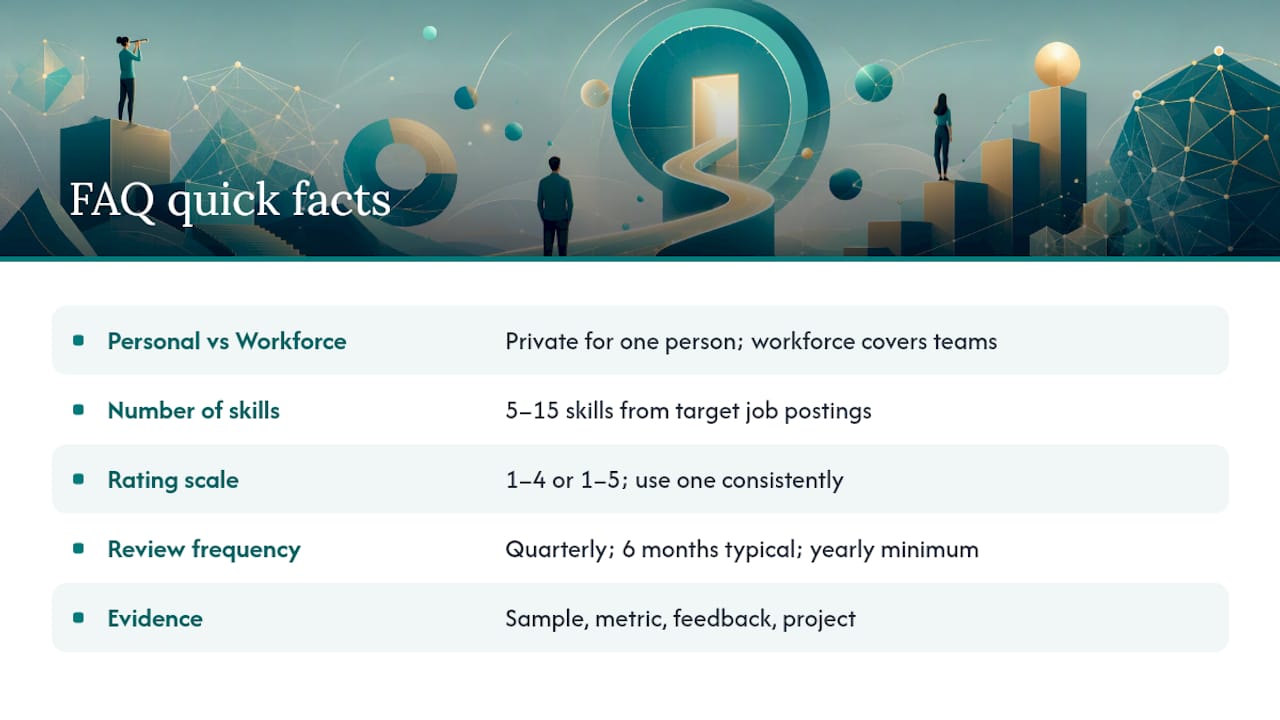
What counts as evidence in a skill gap analysis? A work sample, a metric you influenced, peer or manager feedback, or a completed project tied directly to the skill you're rating.
Sources
- Skills gap analysis overview — Coursera for Enterprise
- Skills gap analysis: know exactly where to focus — MindTools
- Skill Gap Analysis: Flip the Corporate Tool on Yourself — Mirrai Careers
- Skills Gap Analysis: How to Find What's Holding Your Career Back — GigForge